Review: The Glory of the Slave Voyages Database
- jeremiasr4
- Oct 14, 2023
- 4 min read
Slave Voyages Database, https://www.slavevoyages.org/
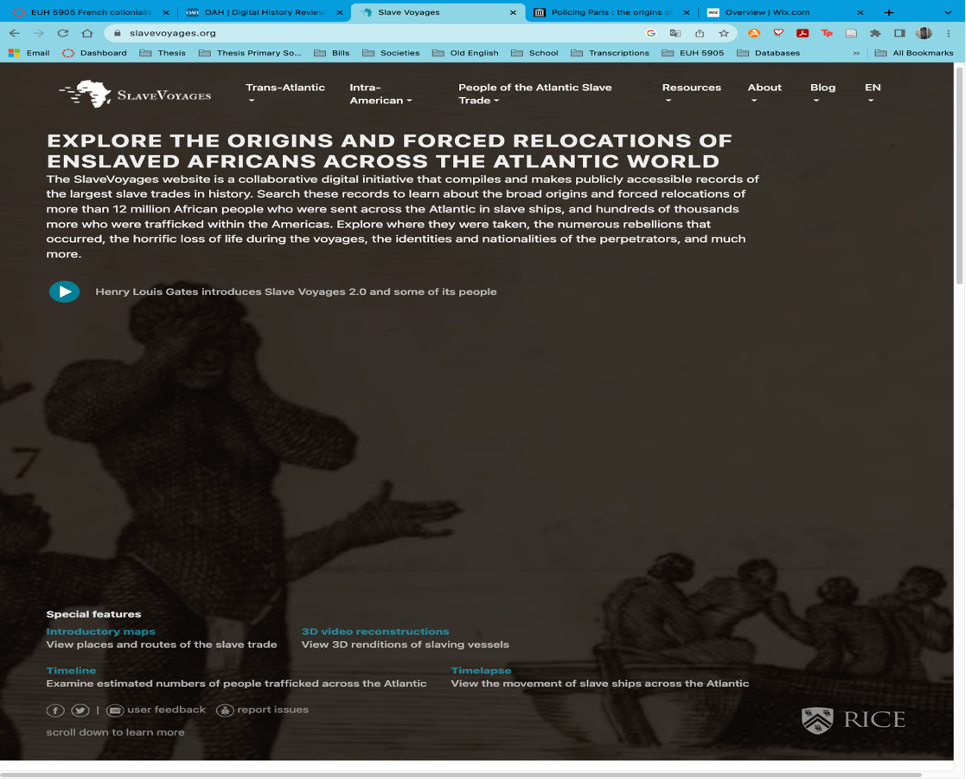
This week’s blog post goal is to review a digital database according to the guidelines of the OAH. The OAH says that a review of digital databases should be evaluated by its Content, Design, Audience, Digital Media, and Creators, so this is the bases that we will use for this review on the Slave Voyages Database. This review will also be looking at if the website is argumentative and contributes to the historiography of the slave trade. As the title pages explains, the database “is a collaborative digital initiative that complies and makes publicly accessible records of the largest slave trades in history.” (Slave Voyages) It allows users to “explore where they were taken, the numerous rebellions that occurred, the horrific loss of life during the voyages, the identities and nationalities of the perpetrators, and much more.” (Slave Voyages) The digital tools that it specifically uses are maps showing the routes, 3D video reconstructions of the ships that were used, a timeline demonstrating the amount of slaves that were traded throughout the Atlantic world with estimated numbers, and a timelapse showing all the movement over time.
This leads us to the content of the database which has already been made clear. Just within the title page of the website, you are given information of exactly what to find on the website, which is listed in the previous paragraph, and shown below. It even provides an introductory video detailing the slave voyages by Henry Louis Gates, a professor of African-American Studies.
Source: Slave Voyages Database, Rice University, accessed Oct. 14, 2023, http://www.slavevoyages.org/
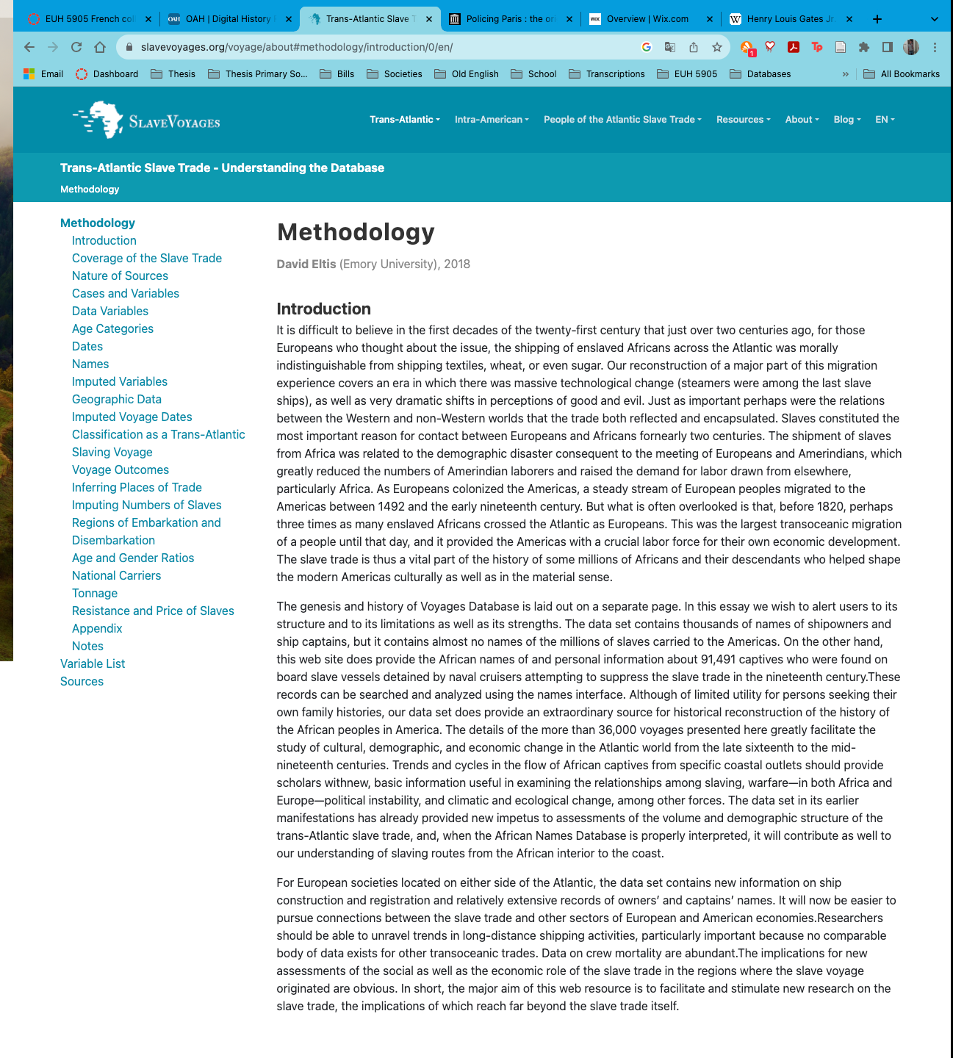
The website is hosted by Rice University and still has twenty-three university-affiliated scholars that work on it and keep it updated. This website provides a detailed “about” tab demonstrating the history of the project, what it’s about, frequently asked questions, a glossary of helpful terms, acknowledgements, those who contributed data, and even a news center. In terms of content, there is a plethora and this website is easily functionable. This database includes information for the Trans-Atlantic, Intra-American, and People of the Atlantic Slave Trade, given sub-tabs that provide information on the database itself and introductory essays, the database itself, downlloads, and even essays written on it.
Source: Slave Voyages Database, Rice University, accessed Oct. 14th, 2023, http://www.slavevoyages.org/
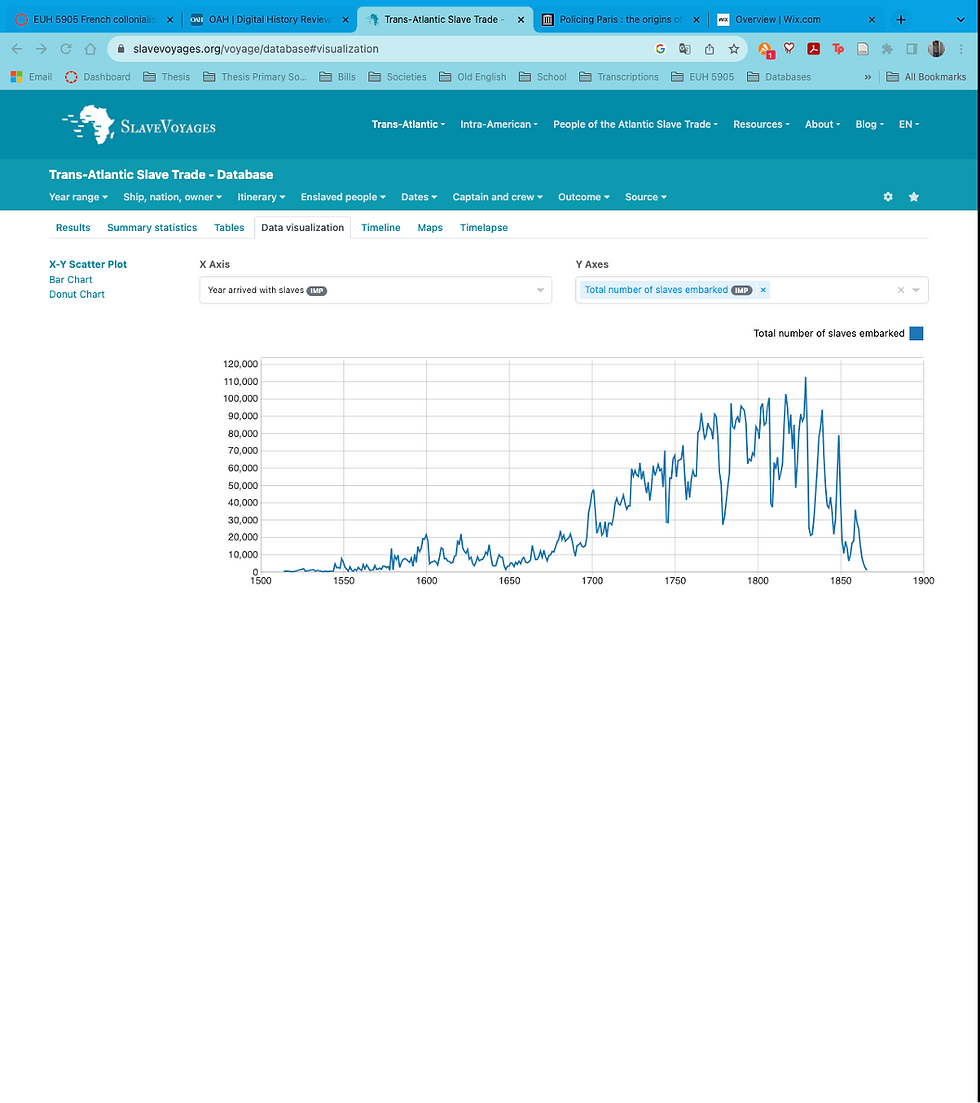
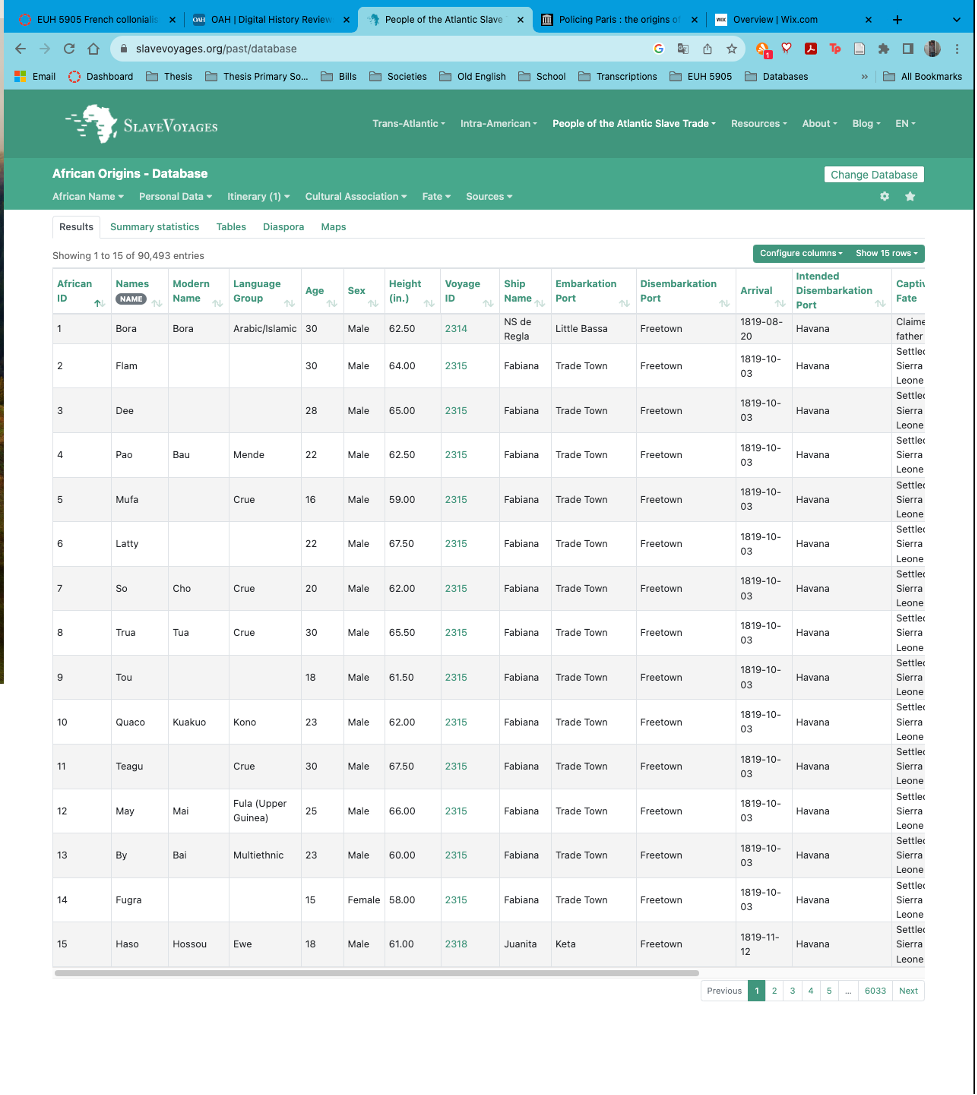
As demonstrated by the caption, there is no lack of information in this database. This website is filled with content for the user to utilize. Some examples of the actual database and information you can find are captioned below. This also demonstrates the OAH’s fourth area that should be evaluated with digital databases: digital media. There is extensive use in multiple ways that data is shown demonstrating the impact of the slave trade, as seen below.
Source: Slave Voyages Database, Rice University, accessed Oct. 14, 2023, http://www.slavevoyages.org/

Source: Slave Voyages Database, Rice University, accessed Oct. 14, 2023, http://www.slavevoyages.org/

Source: Slave Voyages Database, Rice University, accessed Oct. 14, 2023, http://www.slavevoyages.org/
Source: Slave Voyages Database, Rice University, accessed Oct. 14, 2023, http://www.slavevoyages.org/
In fact, I find that the utilization of digital media in the website is by far the most important and beneficial part of this website.
How is the information designed, is it easy to navigate, and many other questions involved in the design of the website are also important to look at. In this aspect, this database passes with flying colors. It is very easy to access, is tablet and mobile friendly, detailed, and works fast. Through my exploring of it, I did not encounter any issues with the website as it seems to be functioning perfectly. If you look on the top right of the screen you will see “EN.” I believe this is extremely beneficial for accessibility as they have a translation to Spanish readily available which allows for a larger audience.
There is a versatility in terms of the audience of this database. I believe the intended audience is for scholars interested in research the slave voyages in the Atlantic World. To be honest, it is not made explicitly clear who the audience of this website is. There are two ways to infer who the intended audience is: one of which implicitly saying it is for secondary educators as there are lesson plans provided for both middle and high school, while on the other hand it is implicitly demonstrating it is for an academic audience based off of endowments that were used such as the National Endowment for the Humanities. My personal opinion is that this can be used for both: academic scholars can benefit from this database to draw conclusions and develop arguments on the Atlantic slave trade, while educators can utilize the timelines, timelapses, and maps to demonstrate the severity of the slave trade. The lack of explicitly explaining the intended audience should not, however, render the website as lacking something, necessarily.
The creators of this project are extensive, and far too many to list. Under the “About” tab you can find information on the project, the history of it, the various teams that the database was worked under from 2008-2015, 2015-2018, 2019-2021, and since March 1, 2021. All of which involving scholars from a multitude of universities. In addition to receiving sponsorships from a variety of societies such as the American Council of Learned Societies, Andrew W. Mellon Foundation, Arts and Humanities Research Council of the United Kingdom, Emory University, Casa de Rui Barbosa Foundation, Hutchins Center for African & African American Research, National Endowment for the Humanities, Cambridge University Press, Yale University Press, University of California-Berkeley, and many, many more. There is not even a seed of doubt that this database was created by a variety of intellectuals drawing from appropriate sources.
This leads to the one portion of the website that I have a small complaint of: the lack of the contribution to the historiography of the Atlantic slave trade. While it does provide a plethora of information for historians to draw conclusions and arguments from, it does not explicitly make any arguments itself. We have discussed in previous blog posts how important this has become in the twenty-first century of digital media, and that is the largest aspect that is missing from this website. So with that being said, in terms of the OAH’s guidelines, the database is up to par and important for the research of the Atlantic slave trade and should be used by Atlantic world historians, but is lacking in the argumentative value.
Comments